

The Purple Vortex Where Subcultures Collide! Maritime Metaphysical & Memorabilia Shoppe |
|
All kinds of Magick!
Grimoires & Books Of Shadows
|
All of us, when we were children, believed in fairies. Here, JOE COOPER tells the extraordinary story of two little girls who not only believed in fairies, but made friends with them–and even captured them on film.
IN THE WEEK BEFORE the end of the First World War, the 11-year-old Frances Griffiths sent a letter to a friend in South Africa, where she had lived most of her life. Dated 9 November 1918, it ran:
Dear Joe [Johanna],
I hope you are quite well. I wrote a letter before, only I lost it or it got
mislaid. Do you play with Elsie and Nora Biddles? I am learning French,
Geometry, Cookery and Algebra at school now. Dad came home from France the other
week after being there ten months, and we all think the war will be over in a
few days. We are going to get our flags to hang upstairs in our bedroom. I am
sending two photos, both of me, one of me in a bathing costume in our back yard,
Uncle Arthur took that, while the other is me with some fairies up the beck,
Elsie took that one. Rosebud is as fat as ever and I have made her some new
clothes. How are Teddy and dolly?
An ordinary and matter-of-fact letter from a schoolgirl to her friend, one might
say, apart from the rather startling reference to fairies. But, as both Frances
and her cousin Elsie Wright have since pointed out (they are now grandmothers),
they were not particularly surprised by seeing fairies; they seemed a natural
part of the rural countryside around the `beck' (stream) at the bottom of the
 long
garden in Cottingley, near Bradford, in
West Yorkshire.
long
garden in Cottingley, near Bradford, in
West Yorkshire.
The photograph enclosed by Frances–the famous one, which has since been
reproduced thousands of times around the world, albeit in an improved and
sharpened version–showed a little girl staring firmly at a camera, since fairies
were frequently to be seen, but she herself was photographed not so often! On
the back of the snap was scrawled in untidy schoolgirl writing:
fairy faery magick knomes dwarfs spirits
Elsie and I are very friendly with the beck Fairies. It is funny I never used to see them in Africa. It must be too hot for them there.
Elsie had borrowed her father's camera–a Midg
quarter-plate–one Saturday afternoon in July 1917 in order to take Frances's
photo and cheer her up (for her cousin had fallen in the beck and been scolded
for wetting her clothes). They were away for about half an hour and Mr. Wright
developed the plate later in the afternoon. He was surprised to see strange
white shapes coming up, imagining them to be first birds and then sandwich
papers left lying around; in vain Elsie behind him in the dark-room said they
were fairies.
 In
August it was Frances who had the camera, when she and Elsie scaled the sides of
the beck and went up to the old oaks. There she took a photograph of Elsie with
a gnome. The print was under-exposed and unclear, as might be expected when
taken by a young lady rising 10 years old. The plate was again developed by
Elsie's father, Arthur, who suspected that the girls had been playing tricks and
refused to lend his camera to them any more.
In
August it was Frances who had the camera, when she and Elsie scaled the sides of
the beck and went up to the old oaks. There she took a photograph of Elsie with
a gnome. The print was under-exposed and unclear, as might be expected when
taken by a young lady rising 10 years old. The plate was again developed by
Elsie's father, Arthur, who suspected that the girls had been playing tricks and
refused to lend his camera to them any more.
Parents turn sleuth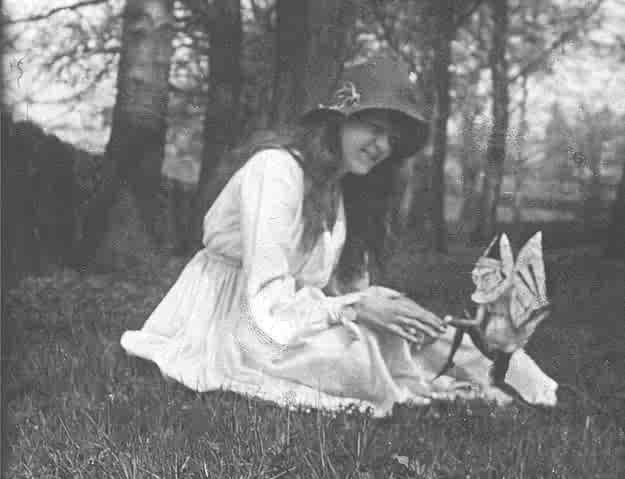
Both Arthur and his wife, Polly, searched the girls' bedroom and waste-paper
basket for any scraps of pictures or cut-outs, and also went down to the beck in
search of evidence of fakery. They found nothing, and the girls stuck to their
story–that they had seen fairies and photographed them. Prints of the pictures
were circulated among friends and neighbours, but then interest in the odd
affair gradually petered out.
The matter first became public in the summer of 1919 when Polly Wright went to a
meeting at the Theosophical Society in Bradford. She was interested in the
occult, having had some experiences of astral projection and memories of past
lives herself. The lecture that night was on `fairy life', and Polly mentioned
to the person sitting next to her that fairy prints had been taken by her
daughter and niece. The result of this conversation was that two `rough prints'
(as they were later called) came to the notice of Theosophists at the Harrogate
conference in the autumn, and thence to a leading Theosophist, Edward Gardner,
by early 1920.
Mr. Gardner was a precise, particular man. Even a look at his photograph conveys
this precision, which is also suggested by the neat copies he kept of his
letters. Gardner's immediate impulse after seeing the fairy pictures was to
clarify the prints and, in a letter to a photographic expert, Fred Barlow, he
describes the instructions he gave to his assistants:
Then I told them to make new negatives (from the positives of the originals) and
do the very best with them short of altering anything mechanically. The result
was that they turned out two first class negatives which … are the same in every
respect as the originals except that they are sharp cut and clear and far finer
for printing purposes…
It seems incredible to us today that he could be so naive, not anticipating the
inevitable questions from critics as to shutter speed, figure definition, the
suspicious resemblance of the fairies' clothes and hairstyles to the latest
fashions … But Gardner only wanted the clearest pictures–as a Theosophist he had
been studying fairy lore for years and had heard many accounts of fairy
sightings, so the possible reactions of sceptics never entered his head.
By a striking coincidence, Sir Arthur Conan Doyle (creator of Sherlock Holmes
and fanatical Spiritualist) had been commissioned by the Strand Magazine to
write an article on fairies for their Christmas issue, to be published at the
end of November 1920. He was preparing this in June when he heard of the two
fairy prints in circulation and eventually made contact with Gardner and
borrowed copies.
From the beginning, contrary to the impression the public later gained of him,
Conan Doyle was on his guard. He showed the prints to Sir Oliver Lodge, a
pioneer psychical researcher, who thought them fakes–perhaps involving a troupe
of dancers masquerading as fairies. One fairy authority told him that the
hairstyles of the sprites were too `Parisienne' for his liking. Lodge also
passed them on to a clairvoyant for psychometric impressions–Gardner's
photoprinter, Mr. Snelling (who had prepared the second batch of prints from the
originals) was described accurately.
What seems rather mysterious to us today is that no one was over-anxious to
examine the original photographs, but seemed content to analyse prints. Snelling
(of whom it had been said `What Snelling doesn't know about faked photography
isn't worth knowing') said in his first report to Gardner on the `rough' print
that he could detect movement in all the fairy figures. Kodak, by contrast,
stated that an experienced photographer may have been involved–which suggests
that the prints that they had been examining may have been sharpened ones.
A possible explanation is that Conan Doyle and Gardner may have wished to avoid
any mention of improving the originals at that stage; perhaps they did not
consider the matter important. What was vital to them was the propagation of
Theosophical and Spiritualist doctrines. As far as they were concerned, clear
prints showing recognisable fairies and a gnome would provide the long-sought
firm evidence for `dwellers at the border' (as Conan Doyle was later to term
nature spirits).
Conan Doyle dispatched his `Watson'–in this real-life case, Gardner–to
Cottingley in July. Gardner reported that the whole Wright family seemed honest
and totally respectable. Conan Doyle and Gardner decided that if further fairy
photographs were taken then the matter would be put firmly beyond question.
Gardner journeyed north in August with cameras and 20 photographic plates to
leave with Elsie and Frances hoping to persuade them to take more photographs.
Only in this way, he felt, could it be proved that the fairies were genuine.
 Meanwhile,
the Strand article was completed, featuring the two sharpened prints, and Conan
Doyle sailed for Australia and a lecture tour to spread the gospel of
Spiritualism. He left his colleagues to face the public reactions to the fairy
business.
Meanwhile,
the Strand article was completed, featuring the two sharpened prints, and Conan
Doyle sailed for Australia and a lecture tour to spread the gospel of
Spiritualism. He left his colleagues to face the public reactions to the fairy
business.
Newspaper sensation
That issue of the Strand sold out within days of publication at the end of
November. Reaction was vigorous–especially from critics. The leading voice among
them was that of one Major Hall-Edwards, a radium expert. He declared:
On the evidence I have no hesitation in saying that these photographs could have
been `faked'. I criticise the attitude of those who declared there is something
supernatural in the circumstances attending to the taking of these pictures
because, as a medical man, I believe that the inculcation of such absurd ideas
into the minds of children will result in later life in manifestations and
nervous disorder and mental disturbances…
Newspaper comments were varied. On 5 January 1921 Truth declared: `For the true
explanation of these fairy photographs what is wanted is not a knowledge of
occult phenomena but a knowledge of children.' On the other hand the South Wales
Argus of 27 November 1920 took a more whimsical and tolerant view: `The day we
kill our Santa Claus with our statistics we shall have plunged a glorious world
into deepest darkness'. The Day's Thought underneath was a Welsh proverb: `Tis
true as the fairy tales told in books.' City News, on 29 January, said
straightforwardly: `It seems at this point that we must either believe in the
almost incredible mystery of the fairy or in the almost incredible wonders of
faked photographs.'
The Westminster Gazette broke the aliases used by Conan Doyle to protect Frances
and Elsie–and a reporter went north. However, nothing sensational, or even new,
was added to the story by his investigation. He found out that Elsie had
borrowed her father's camera to take the first picture, and that Frances had
taken a picture of Elsie and a gnome. In fact there was nothing he could add to
the facts listed by Conan Doyle in his article `Fairies photographed–an
epoch-making event'. The reporter considered Polly and Arthur Wright to be
honest enough folk–and he returned a verdict of `unexplained' to his paper in
London.
The case might well have faded away with the coming of spring in 1921, had not
the unexpected happened: Elsie and Frances took three more fairy photographs.
Captions:
Above: a sharpened version of the first photograph (right), which shows Frances
Griffiths behind a group of dancing fairies. Photographic experts examined the
negative and the print but could find no trace of trickery.
Above: Sir Arthur Conan Doyle, who used sharpened prints of the first two
Cottingley photographs to illustrate his article on fairies, which was published
in the Christmas 1920 issue of the Strand Magazine.
Above: Elsie Wright and her cousin Frances (above right). The girls were close
companions and spent hours playing together near the beck where the fairy
photographs were taken.
Below: Polly Wright, Elsie's mother, began to take the photographs seriously
after she had attended a Theosophical Society lecture on `fairy life'.
Above: A sharpened print of `Elsie and the gnome', the second fairy photograph,
which was taken by Frances in August 1917. The original was examined by experts
in the same way as the first–again no evidence of fakery could be found.
Below: Arthur Wright, Elsie's father, whose camera–a Midg quarter-plate–was used
to take the photographs.
The reappearance of the fairies
The Cottingley `fairy' pictures provoked heated argument. To Sir Arthur Conan
Doyle they were the long-awaited proof of the existence of spirits–but to many
people they were just clever fakes.
IN THE SCHOOL HOLIDAYS of August 192O, Frances Griffiths was asked to come by
train to Cottingley from Scarborough, where she had gone to live with her mother
and father after the First World War. Aunt Polly had written to say that Edward
Gardner would be travelling up from London, with new cameras, so that the
cousins might have further opportunities of taking fairy photographs to add to
the two they took in 1917.
Frances was a month away from her 14th birthday and had won a scholarship to go
to grammar school, being both industrious and intelligent. Elsie, by contrast,
had thankfully left school at the age of 13.
Edward Gardner came from London to Bradford by train and took the tram out to
Cottingley Bar, three miles (5 kilometres) away. He had brought with him two
cameras and two dozen secretly marked photographic plates. He described the
briefing of the girls thus in his book Fairies: a book of real fairies published
in 1945:
I went off, too, to Cottingley again, taking the two cameras and plates from
London, and met the family and explained to the two girls the simple working of
the cameras, giving one each to keep. The cameras were loaded, and my final
advice was that they need go up to the glen only on fine days as they had been
accustomed to do before and tice the fairies, as they called their way of
attracting them, and see what they could get. I suggested only the most obvious
and easy precautions about lighting and distance, for I knew it was essential
they should feel free and unhampered and have no burden of responsibility. If
nothing came of it all, I told them, they were not to mind a bit.
Only two more fairies
One might imagine the scene in the parlour of the Wright household. Beautiful
Polly, listening intently, gangly 19-year-old Elsie with her auburn gold hair
and gentle blue eyes, and sharp Frances, her energies suppressed for the
occasion. (`Pity anyone with corns who is around when Frances gets excited,'
Polly had written wryly on one occasion.) And solemn Edward Gardner, bearded and
perhaps sporting a bow tie as usual, eager to engender some sort of scientific
atmosphere but, in his heart, really not hoping for very much, in spite of the
new cameras and carefully marked plates. So he returned to London, hoping for
fine weather at least.
Alas, it rained for two weeks. They had little opportunity of adding anything to
fairy history, and the first record of anything happening is in a letter to
Gardner from Polly, which is truly astounding in its modesty. She wrote about
the events of Thursday, 19 August 1920:
The morning was dull and misty so they did not take any photos until after
dinner when the mist had cleared away and it was sunny. I went to my sister's
for tea and left them to it. When I got back they had only managed two with
fairies, I was disappointed.
and about those of two days after:
They went up again on Saturday afternoon and took several photos but there was
only one with anything on and it's a queer one, we can't make it out. Elsie put
the plates in this time and Arthur developed them next day.
and what must rank as one of the most charming postscripts ever: `P.S. She did
not take one flying after all.'
So the plates were returned to London. Elsie remembers the care with which they
were packed in cotton wool by her father, who was puzzled–about the whole
affair. He never understood it until the end of his days (he died in 1926) and
Conan Doyle went down in his estimation. Before the great man had shown an
interest in fairies, Arthur held him in high regard; afterwards he found it hard
to believe that so intelligent a man could be bamboozled `by our Elsie, and her
at the bottom of the class!' But whereas Arthur could not bring himself to
believe in fairies, Polly, as the tone of her letter suggests, supported her
daughter and acknowledged the existence of nature spirits.
Gardner was elated to receive the secretly marked plates which bore such
intriguing fairy photographs and telegrams were sent off to Conan Doyle who was
on his Australian lecture tour, currently in Melbourne. Conan Doyle wrote back:
My heart was gladdened when out here in far Australia I had your note and the
three wonderful pictures which are confirmatory of our published results. When
our fairies are admitted other psychic phenomena will find a more ready
acceptance … we have had continued messages at seances for some time that a
visible sign was coming through…
Both Conan Doyle and Edward Gardner were primarily interested in spreading their
own ideas of the infinite to what they considered to be a far from receptive
public. Conan Doyle saw the Cottingley fairies incident as (perhaps literally) a
gift from the gods, paving the way for more profound truths that may gradually
become acceptable to a materialistic world. He used the last three photographs
to illustrate a second article in the Strand Magazine in 1921. It described
other accounts of alleged fairy sightings and served as the foundation for his
later book entitled The Coming of the Fairies, published in 1922.
Reactions to the new fairy photographs were, as before, varied. The most common
criticism was that the fairies looked suspiciously like the traditional fairies
of nursery tales and that they had very fashionable hairstyles. It was also
pointed out that the pictures were particularly sharply-defined as if some
improvement had been made by an expert photographer.
However, some public figures were sympathetic–sometimes embarrassingly so.
Margaret McMillan, the educational and social reformer (who, among other
reforms, brought the benefits of public baths to the slum children of Bradford),
waxed fulsome about the Cottingley incidents: `How wonderful that to these dear
children such a wonderful gift has been vouchsafed.'
Another eminent personality of the day, the novelist Henry de Vere Stacpoole,
decided to take the fairy photographs–and the girls–at face value. He accepted
intuitively that both girls and pictures were genuine. In a letter to Gardner he
said:
Look at Alice's face. Look at Iris's face. There is an extraordinary thing
called TRUTH which has 10 million faces and forms–it is God's currency and the
cleverest coiner or forger can't imitate it…
(The aliases `Alice' and `Iris' first used by Conan Doyle to protect the
anonymity of the girls were deliberately preserved by Stacpoole.)
`Fed up with fairies!'
The fifth, and last, fairy photograph is often believed to be the most striking.
Nobody has ever been able to give a satisfactory explanation as to what seems to
be happening in the picture. However, Conan Doyle, in his The coming of fairies
advances a detailed, if somewhat over-elaborate, view of the pictured
proceedings:
Seated on the upper left hand edge with wing well displayed is an undraped fairy
apparently considering whether it is time to get up. An earlier riser of more
mature age is seen on the right possessing abundant hair and wonderful wings.
Her slightly denser body can be glimpsed within her fairy dress.
This piece of whimsy from the creator of that most unsentimental and coldly
logical character in English fiction–Sherlock Holmes–provided the `Conan Doyle's
going soft' school with formidable ammunition. It is perhaps unfortunate that
his ardent interest in Spiritualism should coincide with his later years,
especially in an age when anyone in his or her sixties was very much considered
`past their best'. His championship of the Cottingley fairies did little to
dispel the growing image of him as a gullible old man. However, he was by no
means the only believer in elemental spirits.
As can be seen from a map of Cottingley, it is virtually on the outskirts of
populous Bradford, and is not, as many imagine, an isolated village. There is a
reservoir and an old water bridge over the `beck'–key markers for the fairy
photographs. Traditionally nature spirits inhabit wooded and watery places and
there are many stories of nature spirits being observed in such secluded spots.
Also, the oak, ash and thorn are traditionally associated with fairies and these
varieties of tree are found around the beck.
In August 1921, a last expedition was made to Cottingley–this time the
clairvoyant, Geoffrey Hodson, was brought along to verify any fairy sightings.
(The feeling being that if anyone, apart from the girls, could see the fairies,
Hodson could.) Alas, the fairies refused to be photographed–although they were
seen both by Hodson and by Elsie.
But by then both Elsie and Frances were tired of the whole fairy business. Many
years later, Elsie looked at a photograph of herself and Frances taken with
Hodson and said: `Look at that–fed up with fairies!' Both Elsie and Frances have
since agreed that they humoured Hodson to a sometimes ludicrous extent. This
naive admission played right into the hands of their critics. Quite apart from
`playing Mr. Hodson along' there were still the allegations of faking the whole
fairy business in the first place and when more fairy photographs were not
forthcoming, the `Cottingley incident' seemed all set to be relegated to the
dusty gallery of `famous fakes'. Yet the episode is not closed….
Captions
Left: a fairy offering flowers to Elsie, 1920. Elsie Wright said that the
flowers were tiny harebells, and that the colours of the fairy's dress were
pastel shades of mauve and yellow. This particular Cottingley photograph
prompted widespread criticism: the fairy has a suspiciously contemporary
appearance, with its bobbed hair and fashionable dress.
Above: the `fairy bower' long believed by some fairylorists to exist, but, as
Conan Doyle exclaimed, `Never before, or other where [sic], has a fairy's bower
been photographed!' The cocoon-like structure is said to be used by fairies to
bathe in after long spells of dull and misty weather.
Below: Cottingley as it was in the 1920s.
Above left: a map of the Cottingley area, showing the `beck' where Elsie and
Frances claimed to have photographed the fairies.
Above: Geoffrey Hodson, a clairvoyant recommended by Sir Arthur Conan Doyle,
pictured here with Elsie, aged 20, and Frances, 14, in 1921. He had personal
experience of fairies and gnomes and was to publish his Fairies at Work and Play
in 1922.
Left: Bernard Partridge's famous caricature of the aging Conan Doyle. Though
still chained by public opinion to his great fictional character Sherlock
Holmes, he is seen with his head in the clouds of Spiritualism.
The Cottingley fairies revisited
Ever since two young girls took `fairy photographs' in the 1920s controversy has
raged over their authenticity.
THE FIRST PHOTOGRAPH of fairies taken by Elsie Wright of Cottingley, near
Bradford, in 1917 has threatened to become overexposed in the occult-conscious
late 20th century, for the photograph of the sprites pictured in front of a
pleasant-faced Frances has been reproduced so often that it is in danger of
becoming a sort of visual cliche. It is especially irritating to those who find
the whole fairy business distasteful, even fraudulent; they object, shrilly at
times, to the strangely artificial look of the fairy dancers–although they are
less vocal on the other four photographs that were subsequently taken. The
believers, as always, believe, and speak of `more things in Heaven and Earth …'
The position of critics on the one hand and champions on the other may be summed
up thus:
The `prosecution' points out that Elsie painted and drew well, that she had
always seemed immersed in drawing fairies, had been fascinated by the art of
photography and had worked at a photographer's, and seemed suspiciously evasive
in the 1971 BBC-TV Nationwide interview. Both Elsie and her cousin Frances admit
to a strong sense of humour; both admit to having deceived the medium Geoffrey
Hodson during the 1921 investigation (in terms of giving overgenerous
endorsements to his descriptions of teeming fairy life in and around the beck).
No third party was ever present when the five photographs were taken. The girls
spent hours together playing down at the beck, which was well away from the
house and concealed, by 40-foot (12-metre) banks, from public view. They shared
a fair-sized attic bedroom in which they could have hatched their plots. In 1978
the `Amazing Randi' (a professional American stage illusionist and
self-appointed debunker of all paranormal phenomena) and a team from New
Scientist subjected the photographs to `enhancement'–a process used to bring out
greater detail from Moon photographs–and thought they could see strings attached
to some figures. Randi also pointed out that the figures in the first photograph
bore a resemblance to those in an illustration in Princess Mary's Gift Book,
published in 1914.
The `defence' asserts that Elsie's job at the photographer's lasted only six
months and amounted to running errands and cleaning up prints. She drew fairies
because she saw them often and, anyway, her drawings were no better than might
be expected from a fairly talented 16-year-old. As for the Gift book
illustrations–fairies dancing around are bound to resemble each other and the
ones in the Christmas 1914 publication lack wings. The string in the report in
New Scientist of 3 August 1978 may be printing streaks, and even real figures
would not stay absolutely motionless in the breeze that usually blew gently down
the beck; and where might they be hung from? And what variety of invisible
`string' was used at the time? By the time Hodson came they were bored and
nodded confirmation for the sake of peace and quiet. Elsie prevaricated because
she wanted the matter to be forgotten. They did not have the motivation,
materials, time, privacy, or expertise to fake the photographs. And, most
significantly, they have always maintained they saw fairies and photographed
them.
Newspapers, magazines and television companies have become increasingly
interested in Elsie and Frances since Peter Chambers of the Daily Express
discovered where Elsie lived in 1966. He quotes Elsie as saying that the fairies
might have been `figments of my imagination'. She may have made this rather bald
statement simply to rid herself of unwelcome publicity. On the other hand she
may have implied that she had successfully photographed these `figments' of her
`imagination'. Significantly, in the years since the Cottingley fairies were
photographed, research into `thoughtography' (notably Dr Jule Eisenbud's work
with Ted Serios in the United States) and experiments in Japan have indicated
that thoughtforms may indeed be photographed.
Elsie and Frances interrogated
For five years Elsie managed to avoid publicity; then, in 1971, BBC-TV's
Nationwide programme took up the case. For 10 days she was interrogated, taken
back to Cottingley and subjected to this sort of thing:
(The interviewer points out that, since the original fairy investigator, E. L.
Gardner, died the year before, Elsie might wish to be more explicit.)
Elsie: I didn't want to upset Mr. Gardner… I don't mind talking now…
(It is then suggested that Elsie's father had a hand in matters.)
Elsie: I would swear on the Bible father didn't know what was going on.
Interviewer: Could you equally swear on the Bible you didn't play any tricks?
Elsie (after a pause): I took the photographs… I took two of them… no, three…
Frances took two…
Interviewer: Are they trick photographs? Could you swear on the Bible about
that?
Elsie (after a pause): I'd rather leave that open if you don't mind… but my
father had nothing to do with it I can promise you that…
Interviewer: Have you had your fun with the world for 50 years? Have you been
kidding us for 10 days?
(Elsie laughs.)
Elsie (gently): I think we'll close on that if you don't mind.
More objective was Austin Mitchell's interview for Yorkshire Television in
September 1976. On the spot where the photographs had allegedly been taken, the
following dialogue took place:
Mitchell: A rational person doesn't see fairies. If people say they see fairies,
then one's bound to be critical.
Frances: Yes.
Mitchell: Now, if you say you saw them, at the time the photograph was taken,
that means that if there's a confidence trick, then you're both part of it.
Frances: Yes–that's fair enough–yes.
Mitchell: So are you?
Frances: No.
Elsie: No.
Frances: Of course not.
Mitchell: Did you, in any way, fabricate those photographs?
Frances: Of course not. You tell us how she could do it–remember she was 16 and
I was 10. So, then, as a child of 10, can you go through life and keep a secret?
The Yorkshire Television team, however, believed the `cardboard cutout' theory.
Austin Mitchell duly appeared on the screen, personable as ever, with a row of
fairy figures before him set against a background of greenery. He flicked them
around a little (perhaps to reassure viewers that elementals had not invaded the
prosaic surroundings of Kirkstall Road, Leeds).
`Simple cardboard cutouts,' he commented on the live magazine programme. `Done
by our photographic department and mounted on wire frames. They discovered that
you really need wire to make them stand up–paper figures droop, of course.
That's how it could have been done.'
But quite apart from the pronouncements of critics and champions, tapes, letters
and newspaper cuttings are now available for anyone who would delve deeper into
the fairy photographs. Understandably, Elsie and Frances would rather people
kept away and respected their privacy after the passage of so many years.
The critics–Lewis of Nationwide, Austin Mitchell of Yorkshire TV, Randi, and
Stewart Sanderson and Katherine Briggs of the Folklore Society–all these are
fair-minded individuals interested in balancing probability on the available
evidence. This extremely delicate balance did seem to have shifted in favour of
the ladies' honesty during the 1970s but, obviously, many points could still be
elucidated by further research.
Austin Mitchell said `a rational person doesn't see fairies', and there are some
sociologists who would say that rationality might be socially constructed. One's
`rationality' mostly depends on one's personal experiences and one's reading.
There are, believe it or not, hundreds of instances of people claiming to have
seen fairies. A perusal of Conan Doyle's book The Coming of the Fairies, or
Visions or Beliefs by Lady Gregory and the poet W. B. Yeats, should prove that
more than a handful of such claims have been made.
The author has now met seven people who claim to have seen nature spirits. One
of them, an ex-wrestler of powerful build–an unlikely figure to consort with
sprites–is adamant in his assertions. It is interesting to note how many are
prepared to listen to him with an unusual degree of tolerance.
It is usually possible to demolish individual accounts; taken collectively,
however, some patterns begin to emerge. F. W. Holiday in his book The dragon and
the disc likens the appearance of the Cottingley gnome to that of lcelandic
Bronze Age figures, and William Riley, the Yorkshire author, puts the five fairy
pictures into perhaps the most relevant context: `I have many times come across
several people who have seen pixies at certain favoured spots in Upper Airedale
and Wharfedale.'
Captions
Above: the young Elsie Wright's watercolour Fairies flying over a cottage. She
often painted fairies, because, she said, she often saw them.
Left: an illustration from Princess Mary's gift book, which was very popular in
1914. These fairies bear some resemblance to those allegedly seen and
photographed at Cottingley.
Below: Fairies by a stream, a watercolour by Elsie Wright. She and her cousin
were obsessed with fairies when they were young and this obsession is used by
both the `defence' and the 'prosecution' to explain the photographs. The
sceptics use it to explain the motivation behind the `fakes' explicitly and the
believers claim that the obsession arose quite naturally because the girls saw
fairies all the time.
Above: a rare `cup and ring' stone, found in Cottingley Glen, close to the beck.
Such strangely marked stones are traditionally associated with supernatural
activities and have often been linked with fairy sightings.
[page 65]
Most people do not believe in fairies and therefore, to them, any alleged fairy
photographs must be fakes. To sceptics there is no question about it: the
Cottingley fairies were cut out of a children's book and superimposed, very
cleverly (for no one has conclusively proved that they were faked) on
photographs of the cousins, Elsie and Frances.
There was no shortage of material had they wanted to search for fairy `models'.
Fairies were common enough in children's books around the turn of the century.
Most girls of their age, living at that time, could have described a fairy, for
most illustrations reflected a similar, traditional fairy image.
In fact, Elsie and Frances's fairies were, if anything, slightly more
fashion-conscious than, say, those pictured in the popular Princess Mary's gift
book of 1914. The Cottingley fairies had up-to-the-minute bobbed hair and beaded
Charleston dresses (although Elsie's gnome remained traditionally grotesque).
When psychical researcher E. L. Gardner visited Cottingley in the 1920s he
claimed mediumistic powers for both girls, but especially for Frances. He
believed that the elemental spirits–fairies–used loosely-knit ectoplasm
emanating from the girls with which to form visible bodies, visible, that is,
only to the girls and the eye of the camera. The exact form they took was, he
hazarded, `chosen' by the subconscious minds of the girls, hence the strange
mixture of traditional and contemporary. But, for whatever reason, both girls
stopped seeing fairies after 1921.
Captions
Several critics pointed out that the Cottingley fairies looked suspiciously
similar to those featured in the advertisement for Price's night lights (above
right). One sceptic, William Marriott, produced this deliberate fake (above
left) by superimposing the `night light' fairies on a picture of Sir Arthur
Conan Doyle.
Some fairies of the era: Left: fairies dancing, by E. Gertrude Thomson from
William Allingham's The Fairies (1886)
Above: a ring of fairies from Florence Harrison's In the fairy ring (1910)
Above right: a girl with fairies, from Princess Mary's Gift Book (1914)
Cottingley: at last the truth
Were there really fairies in the woods at Cottingley? And did two children
succeed in photographing them? In an exclusive interview with JOE COOPER, Elsie
and Frances reveal the truth about the famous Cottingley pictures.
THE COTTINGLEY FAIRY photographs made a journalistic sensation when they first
appeared, in an article in the Strand Magazine, towards the end of 1919. And
ever since they have been regarded as perhaps the most convincing evidence ever
presented for the existence of fairies and the spirit world. But, in late 1981
and mid 1982 respectively, Frances Way (née Griffiths) and Elsie Hill (née
Wright), who took the photographs–now, of course, old ladies–admitted that the
first four pictures were fakes. Speaking of the first photograph in particular,
Frances has told the present author on more than one occasion: `My heart always
sinks when I look at it. When I think of how it's gone all round the world–I
don't see how people could believe they're real fairies. I could see the backs
of them and the hatpins when the photo was being taken.'
How was the hoax set up? It started, as both ladies agree, with the best of
intentions. Frances, she says, was able to perceive many forms of fairy life at
the beck at the bottom of the garden of the Wright household and was,
understandably, continually drawn back to the stream. Occasionally she fell in
and wet her clothes, and was severely told off.
Elsie was much moved by the tears of her cousin, and sympathised with her when
she blurted out to the adults that the reason why she went so often to the
bottom of the garden was because there were fairies to be seen there. Although
Elsie lacked Frances's keen perception of fairy life, she was sensitive to
atmosphere and had a fine appreciation of the mysticism of nature.
Partly to take Frances's mind off her troubles, and partly to play a prank on
grown-ups who sneered at the idea that fairies could be seen, but who cheerfully
perpetuated the myth of Santa Claus, they conspired to produce fairy figures
that they could photograph convincingly. Frances had a copy of Princess Mary's
Gift Book, and the girls used a series of illustrations by Arthur Shepperson as
a model from which Elsie–who had received some art training from the college in
nearby Bradford–constructed the fairy figures. They cut the figures out using
sharp tailor's sissors borrowed from Frances's mother, who worked as a tailoress
in Bradford; they secured them to a bank of earth using hatpins. The girls took
the famous photographs, dropped the cut-out figures into the swirling brook, and
went home. How they gave the film to Mr. Wright, and his surprise at seeing the
fairy figures develop on the prints, is history.
The attitude of Elsie and Frances to the whole question of the fairy photographs
is a typical Yorkshire one–to tell a tall story with a deadpan delivery and let
those who will believe it do so. Indeed, Elsie has often said as much: `I would
rather we were thought of as solemn faced comediennes.'
About a month after the first photograph was taken Elsie felt that she, too,
would like to be photographed with a nature spirit of some kind. She made a
gnome cut-out, which was duly hatpinned into the ground. Frances was a less
expert photographer than Elsie and, according to her, the elongated hand in the
picture is due to `camera slant'; believers in the authenticity of the
photographs have, however, attributed it to `psychic elongation'.
If the second picture is examined, it is easy to see the point of a pin in the
gnome's midriff. But Conan Doyle, after examining the print, concluded that the
point was an umbilicus and that therefore birth in the fairy kingdom might be a
similar process to human birth!
The two photographs were printed and circulated among the girls' friends in the
autumn of 1918, and the matter gradually languished, with neither girl admitting
to the truth of the affair, rather preferring to keep people guessing.
The following year Polly Wright, Elsie's mother, went to some Theosophical
meetings, and so the prints came to be circulated at the Society's conference in
Harrogate in the summer of 1919. By early 1920, they were in the hands of Edward
Gardner, photographic and slide specialist of the Theosophical Society in London
and president of the Blavatsky lodge, and he tried to persuade Polly to ask the
girls to take more photographs. She, however, ignored his letters–and it was not
until Doyle declared his own interest in the subject in June 1920 that matters
began to develop in public.
In the summer of 1920, Gardner at last succeeded in persuading the girls to take
a further series of photographs. These three last photographs were believed by
both Gardner and Conan Doyle to constitute proof that it was possible to
photograph fairies.
Frances, on the other hand, has always marvelled at the fact that anyone could
believe them to be genuine. The flying fairy in the third photograph was pinned
to the branch behind it; it was drawn freehand by Elsie, and seems to Frances to
be out of proportion. The fairy offering flowers to Elsie in the fourth
photograph was attached to a branch in a similar way, and sports a fashionable
hairstyle that has attracted much comment.
The two cousins are divided about the authenticity of the fifth picture. To the
casual eye, it looks very much like the result of a simple overlapping of
photographs, but Frances insists that it was a genuine photograph of fairies.
`It was a wet Saturday afternoon and we were just mooching about with our
cameras and Elsie had nothing prepared,' she says. `I saw these fairies building
up in the grasses and just aimed the camera and took a photograph.' Elsie, on
the other hand, insists that all five photographs are of cut-outs. It must be
borne in mind that Frances has often said that it is as if some psychological
blockage prevents her remembering events surrounding the photographs with any
accuracy; yet this discrepancy in the cousins' accounts of taking the
photographs remains curious.
The second set of photographs was hailed with joy by Gardner. And, trapped by
their first trick, Elsie and Frances had no choice but to remain silent; the
consequences that would have resulted from any disclosures must have seemed
terrifying to them.
Looking for fairies
In 1921, Conan Doyle asked the clairvoyant Geoffrey Hodson to go to Cottingley
to check the girls' observations–essentially, to see if he, too, could see the
fairies. His lengthy descriptions of fairy life, endorsed by the overawed Elsie
and Frances–who saw nothing while Hodson was present, as they disclosed in a
television interview in 1975–appeared as key pages in Doyle's The Coming of the
Fairies in 1922. Hodson went on to become a distinguished writer on
clairvoyance; it is impossible to rule out the possibility that his experience
may actually have been genuine.
This author once asked Elsie point blank whether she could still endorse her
statements to Hodson as reproduced in Conan Doyle's book. `You'll have to make
your own mind up about that, Joe,' she said–again with a suspicion of that
deadpan Yorkshire humour.
What conclusions are there to be drawn? Four of the five pictures, for certain,
are hoaxes. Both Elsie and Frances, however, insist that the fairies themselves
were real. Frances saw them particularly often:
The first time I ever saw anything was when a willow leaf started shaking
violently, even though there was no wind, I saw a small man standing on a
branch, with the stem of the leaf in his hand, which he seemed to be shaking at
something. He was dressed all in green.
Gradually, she began to see more and more of the elves. And in the summer of
1918, Frances saw fairies as well as elves:
They were real fairies. Some had wings and some not…. They were once sitting in
a patch of sunlight on a low bank…. It all seemed so peaceful and friendly….
Sometimes they came up, only inches away, but I never wanted to join in their
lives.
Finally, she says, `I became so used to them that unless they did something
unusual I just ignored them.'
Do fairies exist? Can they be photographed? What is certain is that the
Cottingley photographs cannot be regarded as proof of the existence of fairies.
It is up to each of us to decide whether those people who report seeing fairies
actually see them or whether they merely imagine them.
Captions
The Cottingley fairy photographs were, their originators now admit, copied from
illustrations in Princess Mary's Gift Book. Their champion, Conan Doyle, should
have realised this–his story 'Bimbashi Joyce' (below) appeared in the same book.
Below: the second Cottingley picture, which shows Elsie Wright playing with a
gnome, was taken in August 1917. The point of the hatpin on which the paper
cut-out figure was supported can plainly be seen as a protusion on the gnome's
stomach. Conan Doyle interpreted this as an imbilicus–a clear indication that
birth in the fairy kingdom might be similar to human birth.
Encouraged by Edward Gardner, the photographic and slide specialist of the
Theosophical Society in London, Frances Griffiths and Elsie Wright took three
more photographs at Cottingley during the summer of 1920. The third picture
(above left) shows Frances with a fairy in flight; this was drawn freehand by
Elsie, and attached to the branch behind it with a hatpin. Both Frances and
Elsie admit that the fourth picture (far left) was taken in a similar way–but
Frances maintains that the final picture (left) is genuine: `I saw these fairies
building up in the grasses and just aimed the camera and took a photograph.'
The banks of the beck at Cottingley–where, Frances still maintains, she saw
fairies. So, even if the Cottingley photographs are fakes, whether or not
fairies exist remains an open question.
Source: Cooper, Joe. "Cottingley: At Last the Truth." The Unexplained, No. 117, pp. 2338-40, 1982. This document was scanned from the original publication, and is reproduced here [now] without the photographs, but including the photo captions. The first fairy photo may be found several places on the net, and is included here in Arthur Conan Doyle, Spiritualism, and Fairies.
I thank Peter Brookesmith for supplying photocopies of the original article and Viggo Andersen for the optical scanning and OCR. Any remaining errors are likely mine.
Input and suggestions are welcome at the address shown to the right. If you are commenting on a specific document here, please reference it by name or content.
Return to Donald Simanek's Page, http://www.lhup.edu/~dsimanek
OR THE PURPLE VORTEX
GROOVY STUFF below at The Purple Vortex eBay!

Sacred Seasons, Celebrating Nature Spirituality as a Family © 2006 by October’s Autumn Child. BUY IT HERE


